

ON-WATER NUTRIENT TREATMENT
Floating Module
A marine-grade floating treatment system that brings SWIG's proven media technology directly to stormwater ponds, lakes, and eutrophic water bodies, without requiring any land area for installation. All SWIG systems can be utilized for off-site stormwater credit, BMAP/TMDL allocations, and Water Quality Enhancement Area nutrient banking.

Overview
What is the Floating Module?
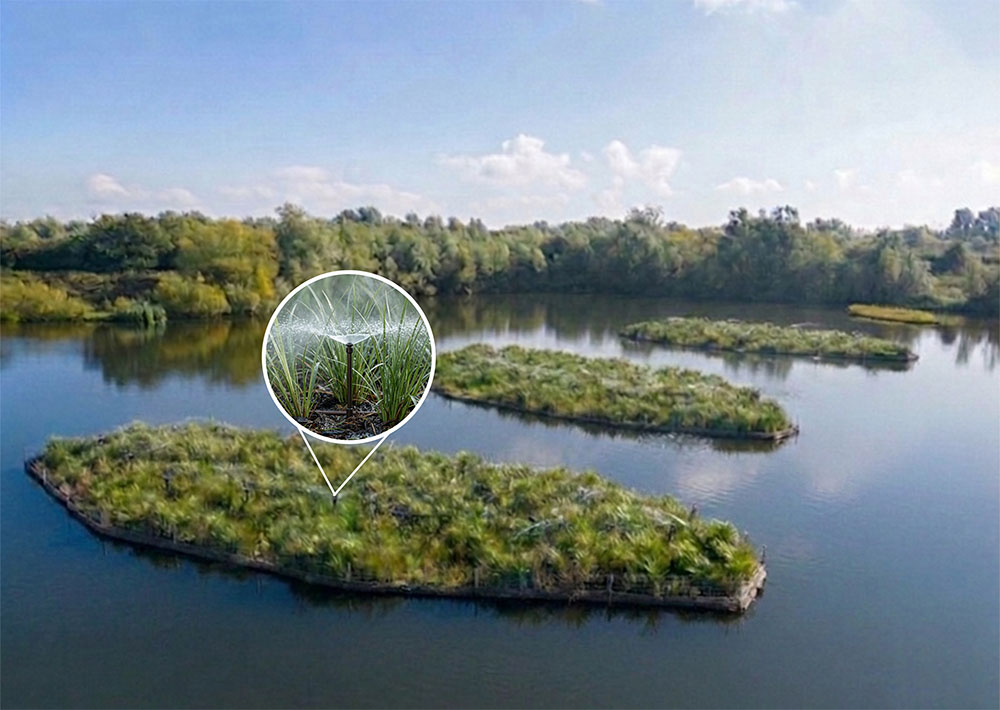
The SWIG Floating Module is a modular, on-water treatment system built on a marine-grade floating platform and frame. Each unit is filled with SWIG's engineered media in either PES or PES+N configuration, allowing treatment to be targeted at phosphorus removal, combined phosphorus and nitrogen removal, or both, depending on the water quality objectives for the site.
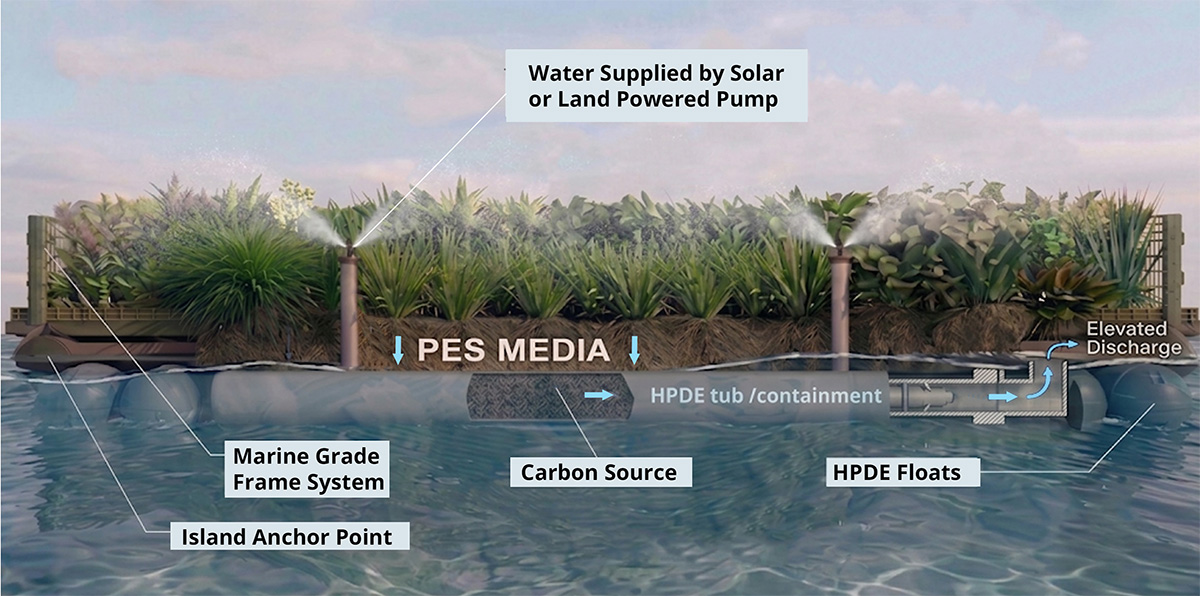
Unlike floating wetlands, the Floating Module does not rely on plant roots for treatment. All nutrient removal is performed by the engineered SWIG media, which delivers consistent and quantifiable performance regardless of seasonal plant growth or senescence. The system pumps water directly from the water body, distributes flows over the vegetated media surface, and discharges treated water back to the same water body, creating a continuous in-situ treatment loop.
Floating Modules can be powered by a land-based electrical source or by dedicated solar arrays mounted on additional floats, making them suitable for remote or off-grid water bodies. Optional fencing can be incorporated into the design to deter waterfowl grazing on the vegetated media surface.
HOW IT WORKS
Treatment process
Water is pumped from the water body
An onboard pump draws water directly from the pond, lake, or water body and conveys it to the media surface for treatment.
Flow is distributed over the engineered media
Water is evenly distributed across the SWIG media surface, percolating vertically through the unsaturated media layer where phosphorus is adsorbed and nitrogen is removed.
Treated water is discharged back to the water body
Treated effluent is collected by the underdrain system and discharged directly back to the water body, completing the treatment cycle without the need for off-site conveyance.
SPECIFICATIONS
System performance and specifications
| Parameter | Value |
|---|---|
| Media configurations | PES, PES+N |
| Typical P removal | 80% – 90% |
| Typical N removal (PES+N) | 60% – 75% |
| Max. loading rate | 1.5 MGD/acre |
| Percolation rate | 20 - 50 in/hr |
| Power source | Land-based grid or solar array |
| Waterfowl deterrent | Optional fencing available |
Nitrogen removal is dependent upon the speciation of nitrogen present and whether a denitrification layer is included in the media configuration.
APPLICATIONS
Where is the Floating Module deployed?
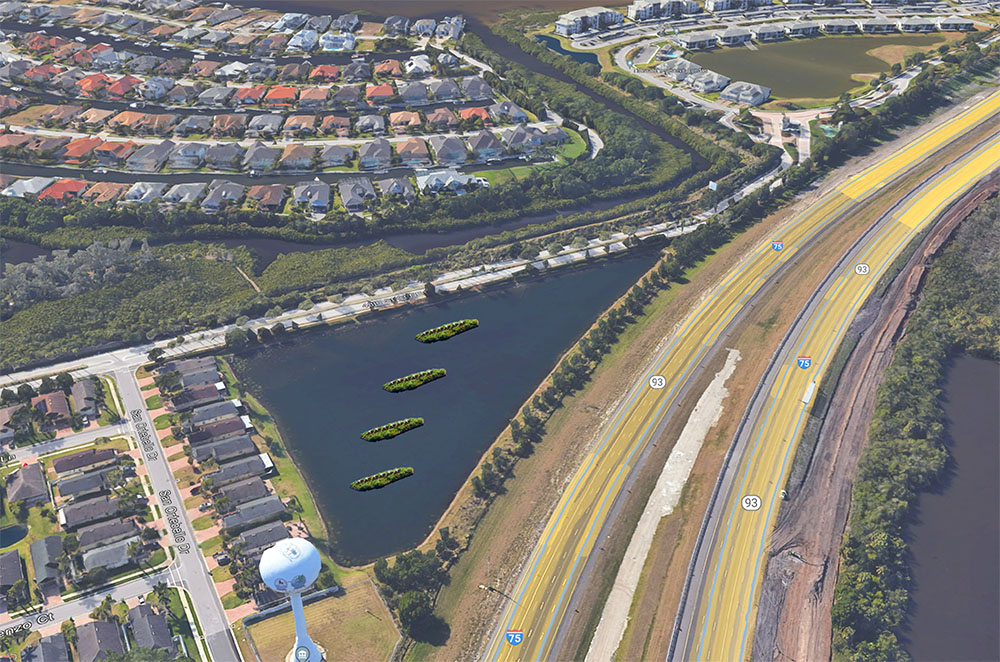
- Stormwater ponds and retention lakes. Ideal for managed stormwater systems where nutrient loading is contributing to water quality degradation or regulatory non-compliance.
- Eutrophic water bodies. Effective for ponds and lakes experiencing algal blooms, excessive aquatic plant growth, or low dissolved oxygen conditions driven by elevated phosphorus and nitrogen loading.
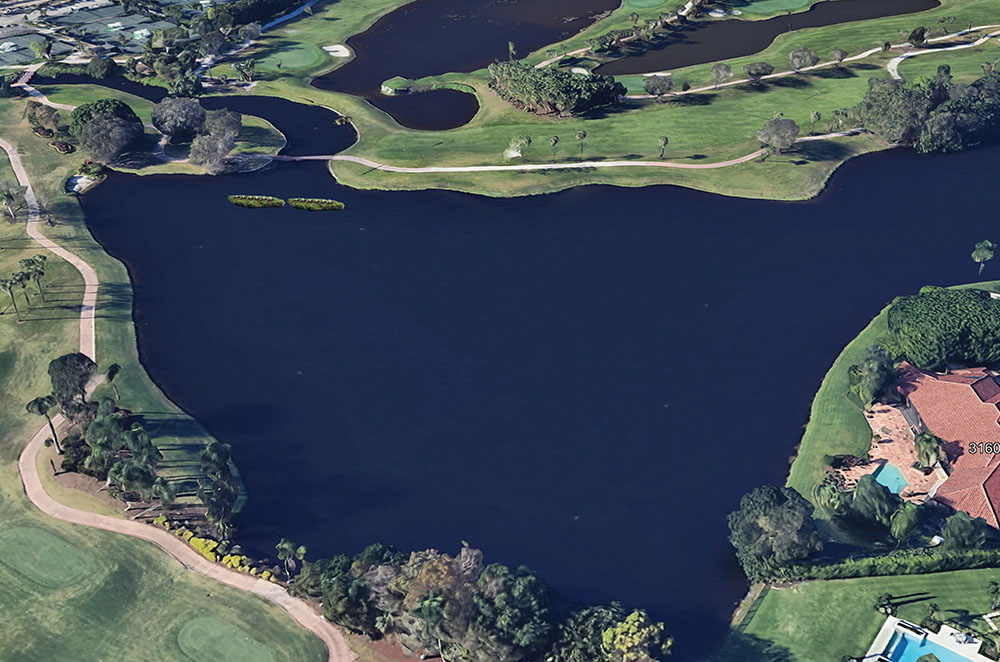
- Golf course water quality management. An ideal solution for golf courses where stormwater ponds receive nutrient-laden runoff from turf and fertilizer applications, and where limited land area makes conventional in-ground treatment systems impractical. The Floating Module can be deployed directly within existing course water features with no disruption to surrounding turf or operations.
- Remote or off-grid water bodies. Solar-powered configurations allow deployment in locations without access to land-based electrical infrastructure.
- Sites with no available land area. Because the system is entirely water-based, it is suited to built-out or constrained sites where in-ground systems cannot be accommodated.
Stormpond
Golf Course
KEY ADVANTAGES
Why choose the Floating Module?
- Media-driven treatment, not plant-dependent. All nutrient removal is performed by SWIG's engineered media, providing reliable and measurable performance independent of vegetation.
- In-situ treatment. Water is pumped, treated, and returned to the same water body, eliminating the need for off-site conveyance infrastructure.
- Flexible power options. Systems can be connected to land-based power or configured with solar arrays mounted on supplemental floats for fully off-grid operation.
- Scalable configurations. Multiple floating modules can be linked and deployed together to meet higher treatment volumes or larger water body coverage.
- Waterfowl deterrent option. Integrated fencing can be incorporated to protect the vegetated media surface from waterfowl grazing.
- Fully automated and remotely monitored. Systems operate automatically and are controlled and monitored remotely, with performance data tracked in real time.
- Marine-grade construction. Built on durable floating platform and frame components rated for long-term aquatic deployment.
FULL-SERVICE PROJECT SUPPORT
Design and operations services
SWIG provides a complete suite of design and operational support services, ensuring Floating Modules are properly sized, configured, and performing from day one through the life of the project. Our team works directly with clients from initial feasibility through long-term operations, reducing the burden on project owners and ensuring treatment goals are consistently met.
Services include:
- Feasibility assessment. Water body evaluation and preliminary sizing based on target parameters, water quality data, and treatment objectives.
- Hydraulic and treatment design. Detailed module sizing, media selection, and loading calculations tailored to site-specific conditions.
- Site layout and engineering drawings. Construction-ready design documents for permitting and contractor use.
- Permitting support. Technical documentation and agency coordination to support regulatory approvals.
- Construction oversight. On-site support during installation to ensure design intent is met.
- System operations, maintenance, and performance monitoring. Remote system control, scheduled maintenance, real-time performance tracking, and regular reporting to verify treatment targets are consistently achieved.
OPERATIONS and MAINTENANCE
Low-maintenance by design
The Module is designed for long-term, low-intervention operation. O&M activities include:

Electrical or Solar System Costs
Associated with powering the pump and control systems. Solar-configured systems reduce or eliminate ongoing electrical costs.

Water Quality Sampling
Periodic sampling to verify treatment performance and confirm water quality improvements in the receiving water body.

Vegetation and media inspection
Periodic inspection of the media surface and vegetated cover to assess performance and condition.

Media Replacement
Media replacement as needed based on adsorptive capacity, typically every 5 to 15 years depending on influent loading conditions.
MORE INFORMATION
MEDIA REPLACEMENT
Long-life media with end-of-life reuse
SWIG Floating Module media is engineered for durability, with design lifetimes ranging from 10 to 15 years depending on influent phosphorus loads. Systems treating lower nutrient concentrations will experience slower media saturation, extending operational life toward the upper end of this range.
When media reaches adsorptive capacity, it is removed and beneficially reused as an agricultural soil amendment, consistent with SWIG’s cradle-to-cradle sustainability approach.
Longevity: Systems treating lower phosphorus concentrations experience slower saturation, maximizing media life and deferring replacement costs.
Design consideration: While SWIG media blends have high infiltration rates, high suspended sediment loads in the source water can impact media longevity and performance. Pre-screening or settling should be evaluated where sediment loading is a concern.