

NATURE-BASED STORMWATER TREATMENT
Stormwater BMPs
Industry-leading, nature-based media filtration systems engineered to comply with Florida's new Stormwater Rule, remove multiple pollutants simultaneously, and create green space and ecological value within the built environment.
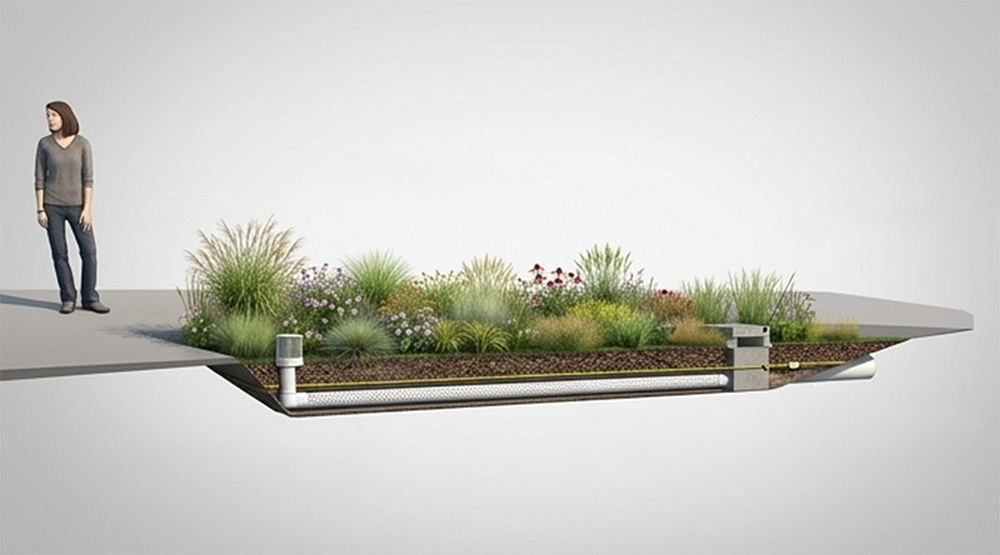

Overview
What are SWIG Stormwater BMPs?
SWIG Stormwater Best Management Practices (BMPs) are nature-based media filtration systems that deliver industry-leading pollutant removal performance for residential, commercial, and transportation stormwater applications. Formulated to handle the variable flow conditions and complex pollutant mixtures characteristic of stormwater runoff, SWIG media removes nutrients, metals, bacteria, and total suspended solids simultaneously, in a single passive treatment system.
SWIG BMP systems are deployed as bioswales, raingardens, and other low impact development (LID) infrastructure, incorporating wetland plantings to create functional green space, wildlife habitat, and aesthetically pleasing landscapes. They are approved by both the Florida Department of Environmental Protection (FDEP) and Water Management Districts, and are designed from the ground up to comply with Florida's new Stormwater Rule.
SWIG's technical staff provides full design assistance and specifies the appropriate media blend for each application, ensuring performance targets are met within the constraints of the available site area and project life span.
HOW IT WORKS
Treatment process
Stormwater runoff enters the BMP
Runoff from impervious surfaces, roadways, or developed land is directed into the bioswale, raingarden, or BMP structure, where it is retained for treatment.
Water filters through SWIG engineered media
As stormwater percolates through the engineered media layer, phosphorus is adsorbed, nitrogen is removed, metals are captured, bacteria are treated, and total suspended solids are filtered, all in a single pass.
Treated water is discharged or infiltrated
Treated stormwater is either discharged to the downstream conveyance system at significantly reduced pollutant concentrations, or infiltrated into the soil, depending on the site design.
Optional — Enhanced Nitrogen Removal:
SWIG dual-outlet controls can be incorporated at the discharge end of the BMP to improve nitrogen removal. By managing water levels within the system, dual-outlet controls extend hydraulic retention time and promote denitrification conditions within the media, improving total nitrogen removal performance beyond standard BMP configurations.
SPECIFICATIONS
Removal performance and specifications
| Parameter | Performance |
|---|---|
| Total phosphorus removal | > 50% |
| Total nitrogen removal | 20 – 30% |
| TSS removal | 95% |
| Metals removal | 80 – 95% |
| Media design lifetime | 10 – 15 years |
| Regulatory compliance | Florida Stormwater Rule, FDEP, WMDs |
Performance based on 25-year project lifetime removal data. Actual performance varies by media blend, application type, and site-specific loading conditions.
APPLICATIONS
Where are SWIG BMPs deployed?
- Bioswales. Vegetated linear channels that convey and treat stormwater runoff along roadways, parking lots, and development boundaries, replacing conventional curb and gutter systems with a nature-based alternative.
- Raingardens. Shallow, planted depressions that capture and treat runoff from rooftops, driveways, and small impervious areas, ideal for residential and small commercial applications.
- Residential and commercial development. Integrated into site stormwater management plans to meet water quality treatment requirements for new development and redevelopment projects under Florida's Stormwater Rule.
- Transportation agencies. Deployed along highways, roads, and transit corridors to treat roadway runoff containing metals, nutrients, hydrocarbons, and suspended sediments before discharge to receiving waters.
- Water quality mitigation banks and credit generation. Qualifying systems can generate nutrient removal credits to meet Basin Management Action Plan (BMAP) allocations and satisfy off-site stormwater treatment offset requirements under Environmental Resource Permit (ERP) conditions.
REGULATORY COMPLIANCE
Meeting Florida’s new Stormwater Rule
SWIG Stormwater BMPs are designed to comply with Florida's new Stormwater Rule and meet the performance standards required by FDEP and the Water Management Districts. Key regulatory benefits include:
- Florida Stormwater Rule compliance. Systems are engineered to meet the nutrient reduction requirements established under Florida's updated stormwater management framework.
- Environmental Resource Permit support. SWIG BMPs can generate off-site stormwater treatment offsets and satisfy ERP stormwater quality conditions for qualifying projects.
- Basin Management Action Plan credits. Documented nutrient removal performance can be applied toward BMAP allocations, providing a quantifiable and verifiable compliance pathway for regulated entities.
- FDEP and Water Management District approval. SWIG media products are approved by both FDEP and Florida's Water Management Districts for use in stormwater treatment applications.
KEY ADVANTAGES
Why choose SWIG Stormwater BMPs?
- Industry-leading removal performance. SWIG media delivers verified, long-term removal of phosphorus, nitrogen, TSS, metals, pathogens, PAHs, PCBs, and endocrine disrupting compounds in a single system.
- Florida Stormwater Rule compliant. Designed from the ground up to meet current and forthcoming Florida stormwater regulatory requirements.
- Nature-based with ecological co-benefits. Wetland plantings create green space, wildlife habitat, and aesthetically pleasing landscapes within developed areas.
- Reduces stormwater pond size. Higher treatment efficiency per unit area allows pond sizes to be reduced, freeing land area for developable use.
- Generates regulatory credits. Systems can produce nutrient removal credits for BMAP and ERP compliance, enabling off-site stormwater treatment offsets.
- Non-toxic, no chemicals, no byproducts. SWIG manufactures filter media from recycled and natural materials. No chemicals are added during treatment and no waste byproducts are generated.
- Passive and easy to operate. Systems rely on gravity-driven flow and require no active chemical dosing or complex mechanical operation.
- Flexible deployment. Compatible with point and non-point source applications across a wide range of site types and scales.
- Fully monitorable. Systems can be instrumented to verify mass load removals, supporting permit compliance and performance reporting where required.
- Designed for project life spans of 10 to 15 years. Media blends and system sizing are tailored to meet treatment targets across the full intended project life.
- 80/80 nutrient removal achievable with RE-Treat. For projects with more stringent nutrient reduction requirements, the SWIG RE-Treat system, used in combination with a stormwater pond, can achieve 80/80 removal targets, meaning 80% removal of both total phosphorus and total nitrogen. This integrated approach combines the adsorptive performance of SWIG media with the additional retention and biological treatment capacity of a stormwater pond, providing a clear compliance pathway for projects subject to enhanced nutrient removal standards.
FULL-SERVICE PROJECT SUPPORT
Design and operations services
SWIG provides a complete suite of design and operational support services, ensuring BMP systems are properly sized, specified, permitted, and performing from day one through the life of the project. Our technical staff works directly with engineers, developers, and agencies from initial feasibility through long-term operations.
Services include:
- Feasibility assessment. Site evaluation and preliminary sizing based on drainage area, target parameters, flow characteristics, and regulatory requirements.
- Media specification and design assistance. Selection of the appropriate SWIG media blend and system configuration to meet site-specific pollutant removal objectives and project life span requirements.
- Hydraulic and treatment design. Detailed system sizing and loading calculations tailored to site conditions and applicable design standards.
- Site layout and engineering drawings. Construction-ready design documents for permitting and contractor use.
- Permitting support. Technical documentation and agency coordination to support FDEP, Water Management District, and local regulatory approvals.
- Construction oversight. On-site support during installation to ensure design intent and media placement specifications are met.
- System operations, maintenance, and performance monitoring. Scheduled maintenance, periodic water quality sampling, real-time performance tracking, and regular reporting to verify treatment targets are consistently achieved.
OPERATIONS and MAINTENANCE
Low-maintenance by design
SWIG Stormwater BMP systems are designed for long-term, low-intervention operation consistent with passive green infrastructure. O&M activities include:

Vegetation Management
Periodic inspection and maintenance of wetland plantings to ensure healthy establishment and prevent encroachment of invasive species.

Sediment and Debris Removal
Periodic removal of accumulated sediment and debris from inlet structures and media surfaces to maintain hydraulic performance.

Water Quality Sampling
Periodic sampling to verify treatment performance and support permit compliance reporting where required.

Media Inspection and Replacement
Periodic inspection of media performance with replacement as needed based on adsorptive capacity, typically every 10 to 15 years depending on site loading conditions.
MORE INFORMATION
MEDIA REPLACEMENT
Long-life media with end-of-life reuse
SWIG BMP media is engineered for durability, with design lifetimes of 10 to 15 years depending on site-specific pollutant loading. Lower pollutant concentrations extend media life toward the upper end of this range, maximizing the return on infrastructure investment.
When media reaches adsorptive capacity, it is removed and beneficially reused as an agricultural soil amendment, consistent with SWIG’s cradle-to-cradle sustainability approach. Sourced from recycled materials, the media offers an end-to-end sustainability benefit: reusing a waste product, removing harmful pollutants, then reusing spent media to replace fertilizer and reduce downstream phosphorus leaching.
Longevity: Systems treating lower pollutant concentrations experience slower media saturation, maximizing media life and deferring replacement costs.
Design consideration: High sediment loads in stormwater runoff can reduce media longevity and hydraulic performance over time. Pre-treatment sediment separation should be evaluated and incorporated into system design where high TSS loading is anticipated.