

COMPREHENSIVE STORMWATER POND TREATMENT
RE-Treat
A passive, nature-based stormwater pond solution that combines SWIG media technology with existing pond infrastructure to meet Florida’s most stringent nutrient removal requirements, without building larger ponds.

Overview
What is RE-Treat?
RE-Treat is a comprehensive stormwater pond treatment solution that uses SWIG’s proven PES+N media, deployed as a field system or module, to directly treat storm flows and continuously recirculate and treat pond water during normal stage conditions. The system is designed to comply with Florida’s new Stormwater Rule and meet the nutrient removal targets required for new development, redevelopment, and regulated stormwater discharges.
Rather than building larger ponds to achieve compliance, RE-Treat integrates directly with existing or planned stormwater ponds, using a media bed that occupies approximately 10 percent of the pond surface area. The system operates passively under wet conditions and actively recirculates when the pond stage returns to normal after a rain event, treating up to 20 pond volumes per year.
RE-Treat is ideally suited for homeowners' associations (HOAs), commercial developments, and any project that includes a stormwater pond and is subject to nutrient removal permit conditions.
HOW IT WORKS
Treatment process
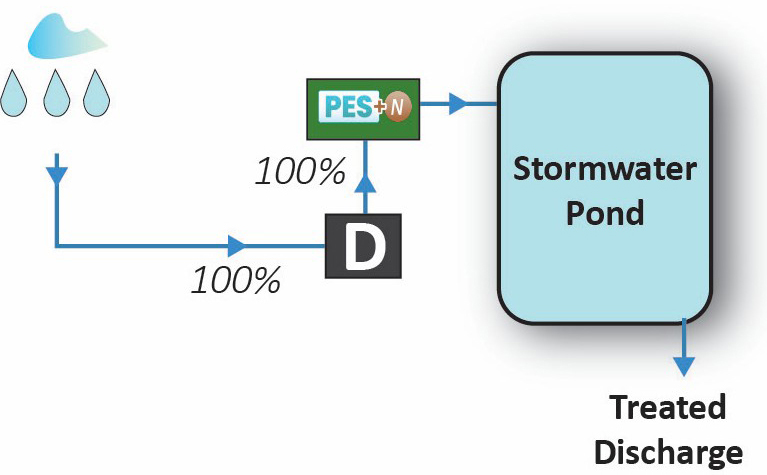
Scenario 1: Normal Rain
100% of storm flows diverted to the media bed - During typical rain events, all stormwater flows are diverted to the RE-Treat media bed for direct treatment through SWIG PES+N media before discharge from the stormwater pond.
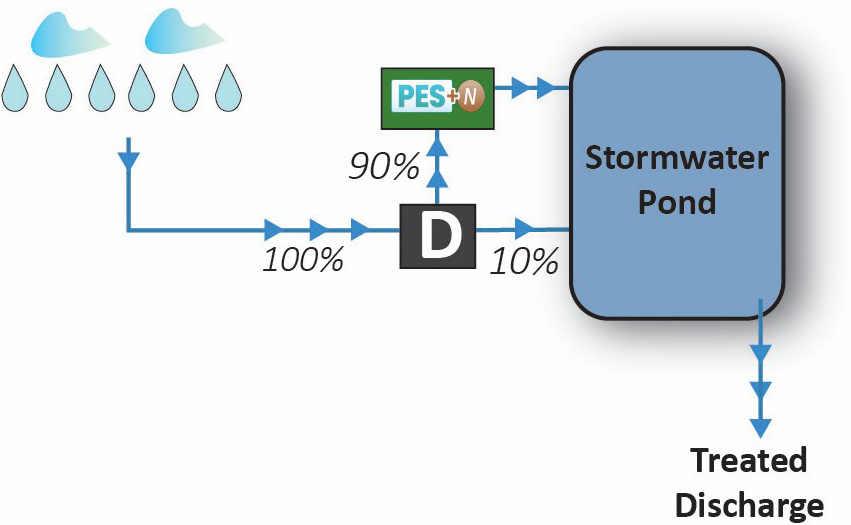
Scenario 2: Heavy Rain
Up to 90% of storm flows are diverted to the media bed - During larger storm events, the media bed receives up to 90% of incoming flows. The stormwater pond manages the remaining volume and discharges partially treated flows, while the media bed continues active treatment at capacity.
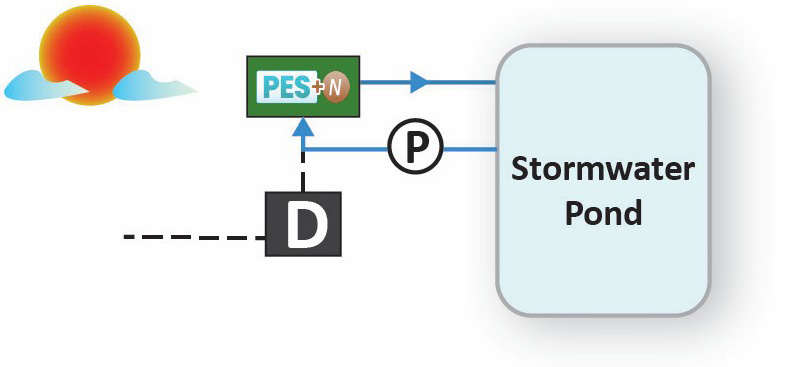
Scenario 3: Post-rain and dry periods
Pond recirculation treats water at 3 ft/day - Once the pond stage returns to normal following a rain event, float controls activate the pump to recirculate pond water through the media bed at 3 feet per day. This continuous recirculation treats up to 20 pond volumes annually, addressing internally generated nutrient loads, including nitrogen fixed by algae within the pond.
Design Note:
The media bed is set at an elevation 2.5 feet above normal pond stage and is directly connected to the pond during large storm events, providing passive overflow capacity with no mechanical intervention required. The field system component can handle loading rates of up to 10 feet per day before flows are diverted.
DESIGN and PERFORMANCE
System specifications
| Parameter | Value |
|---|---|
| Field system loading rate | Up to 10 ft/day before diversion |
| Media bed elevation | 2.5 ft above normal pond stage |
| Media bed area | ~10% of pond surface area |
| Post-rain recirculation rate | 3 ft/day |
| Annual pond volume treatment | Up to 20 pond volumes |
| Phosphorus removal | > 90% |
| Nitrogen removal | 80% |
| Media top dressing | 2 in. high-density mulch, replaced on 2-year cycles |
| Flow diversion | Gravity diversion box with adjustable weir elevations |
| Pump control | Float switch and simple pump logic |
Performance targets are based on PES+N media configuration. Actual results vary by site-specific loading conditions, pond geometry, and media bed sizing.
APPLICATIONS
Who is RE-Treat designed for?
- Homeowners associations (HOAs). Community stormwater ponds receiving nutrient-laden runoff from lawns, landscaping, and impervious surfaces, where pond water quality and algal bloom management are ongoing concerns.
- Commercial development. New and redevelopment projects required to meet enhanced nutrient removal standards under Florida’s Stormwater Rule or site-specific Environmental Resource Permit conditions.
- Any project with a stormwater pond. RE-Treat integrates with virtually any stormwater pond configuration, making it a flexible solution for projects across residential, commercial, industrial, and institutional land uses.
- Projects avoiding pond expansion. Sites where land constraints, cost, or permitting limitations make it impractical to enlarge pond footprints to meet compliance targets.
KEY ADVANTAGES
Why choose RE-Treat?
- Meets >90% phosphorus and 80% nitrogen removal. RE-Treat delivers the highest nutrient removal performance of any passive stormwater pond treatment system, meeting and exceeding Florida’s most stringent permit requirements.
- No need for larger ponds. By treating storm flows and recirculating pond water through high-performance SWIG media, RE-Treat achieves compliance without expanding pond footprint or reducing developable area.
- Treats algal nitrogen at the source. Stormwater ponds naturally generate nitrogen through algal fixation. RE-Treat’s recirculation cycle removes this internally generated nitrogen load, addressing a nutrient source that conventional systems cannot treat.
- Simple, reliable controls. Float switch-activated pump logic ensures the system operates automatically and only when needed, with no recirculation during low pond stage conditions.
- Florida Stormwater Rule compliant. Designed specifically to meet Florida’s updated stormwater management requirements for nutrient reduction in association with stormwater ponds.
- Passive treatment with active recirculation capability. Gravity-driven treatment during storm events, combined with pump-driven recirculation during dry and post-storm periods, provides comprehensive year-round nutrient management.
- Media topped with high-density mulch. A 2-inch layer of high-density mulch on the media surface supports vegetation establishment, reduces erosion, and is replaced on a 2-year maintenance cycle.
FULL-SERVICE PROJECT SUPPORT
Design and operations services
SWIG provides a complete suite of design and operational support services for RE-Treat systems, ensuring each installation is properly sized, permitted, and performing from day one through the life of the project. Our team works directly with developers, engineers, HOA managers, and regulatory agencies from initial feasibility through long-term operations.
Services include:
- Feasibility assessment. Pond evaluation and preliminary sizing based on drainage area, target parameters, flow volumes, and applicable permit requirements.
- Hydraulic and treatment design. Detailed media bed sizing, PES+N media specification, diversion structure design, and pump system sizing tailored to site-specific conditions.
- Site layout and engineering drawings. Construction-ready design documents for permitting and contractor use.
- Permitting support. Technical documentation and agency coordination to support FDEP, Water Management District, and local regulatory approvals.
- Construction oversight. On-site support during installation to ensure design intent and media placement specifications are met.
- Long-term O&M contracts. SWIG offers ongoing operations and maintenance contracts, providing system inspections, performance monitoring, water quality sampling, vegetation management, and mulch replacement, ensuring permit compliance is maintained throughout the system’s life.
- System operations, maintenance, and performance monitoring. Remote system control, scheduled maintenance, real-time performance tracking, and regular reporting to verify treatment targets are consistently achieved.
OPERATIONS and MAINTENANCE
Low-maintenance by design
SWIG Stormwater BMP systems are designed for long-term, low-intervention operation consistent with passive green infrastructure. O&M activities include:

Electrical Costs
Associated with pump operation during post-rain recirculation cycles. Float switch controls limit pump runtime to periods when pond stage is at or above normal, minimizing energy use.

Water Quality Sampling
Periodic sampling of pond inflow and outflow to verify nutrient removal performance and support permit compliance reporting.

Mulch Replacement
The 2-inch high-density mulch layer on the media surface is inspected periodically and replaced on a 2-year cycle to maintain hydraulic performance and vegetation cover.

Vegetation Management
Periodic inspection and maintenance of wetland plantings on the media bed surface to ensure healthy establishment and prevent invasive species encroachment.
Media Inspection and Replacement
Periodic inspection of media performance with replacement based on adsorptive capacity, typically every 10 to 15 years depending on influent loading conditions.
MORE INFORMATION
MEDIA REPLACEMENT
Long-life media with end-of-life reuse
RE-Treat media is engineered for durability, with design lifetimes ranging from 5 to 15 years depending on site-specific phosphorus and nitrogen loading. Systems treating lower nutrient concentrations will experience slower media saturation, extending operational life toward the upper end of this range.
When media reaches adsorptive capacity, it is removed and beneficially reused as an agricultural soil amendment, consistent with SWIG’s cradle-to-cradle sustainability approach.
Longevity: Lower influent nutrient concentrations result in slower media saturation, maximizing media life and deferring replacement costs.
Design consideration: High suspended sediment loads in stormwater runoff can reduce media longevity and hydraulic performance. Pre-treatment sediment separation should be evaluated where high TSS loading is anticipated.