

MOBILE WATER TREATMENT
Module
A compact, deployable treatment unit that brings SWIG's proven media technology to urban spaces, temporary applications, and sites where in-ground systems are not feasible.

Overview
What is the Module?
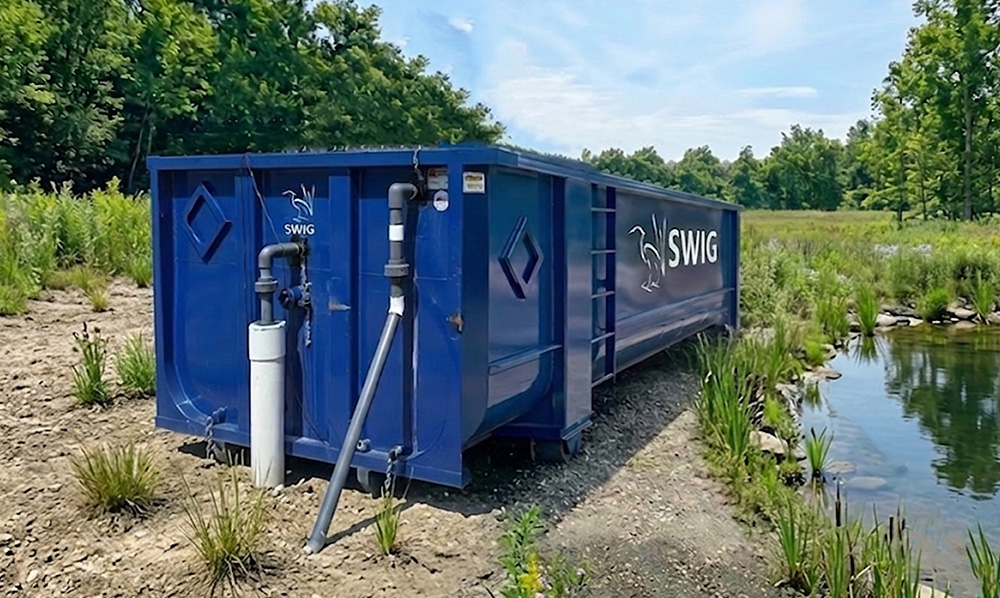
The SWIG Module is a prefabricated, mobile steel treatment unit that delivers the same high-performance nutrient and pollutant removal as SWIG's field systems, in a compact and rapidly deployable format. Mounted on a skid and built for transport, the Module can be positioned in urban environments, installed at temporary project sites, or deployed where excavation or in-ground construction is not possible due to utilities, site constraints, or access limitations.
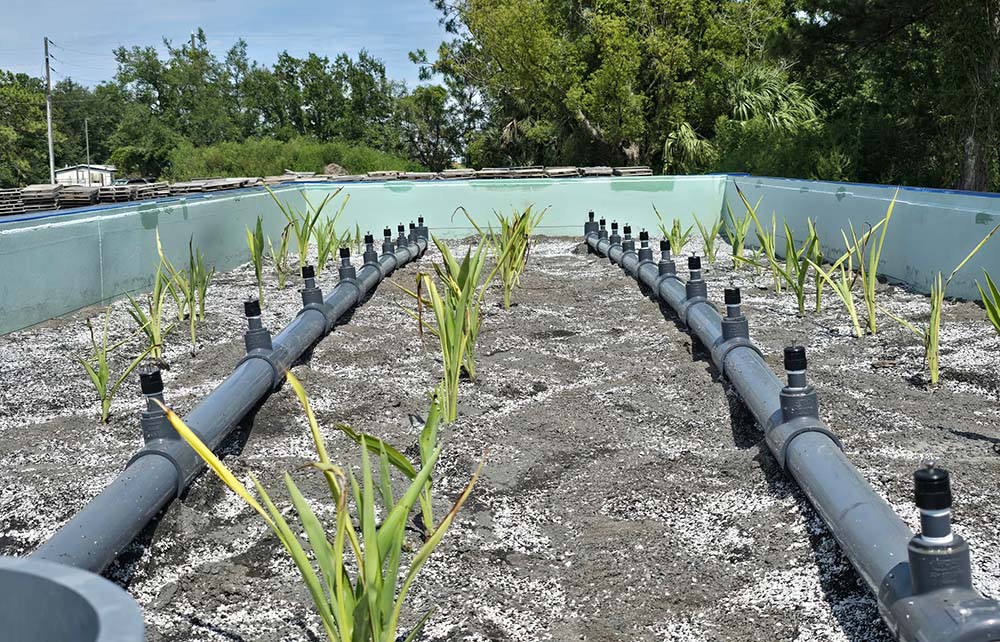
Each Module is filled with SWIG's engineered treatment media and configured to target the specific parameter of concern, whether phosphorus, nitrogen, color, or a combination. Like all SWIG systems, the Module is designed to operate automatically and can be controlled and monitored remotely, requiring minimal on-site presence.
HOW IT WORKS
Treatment process
Water is distributed across the media surface
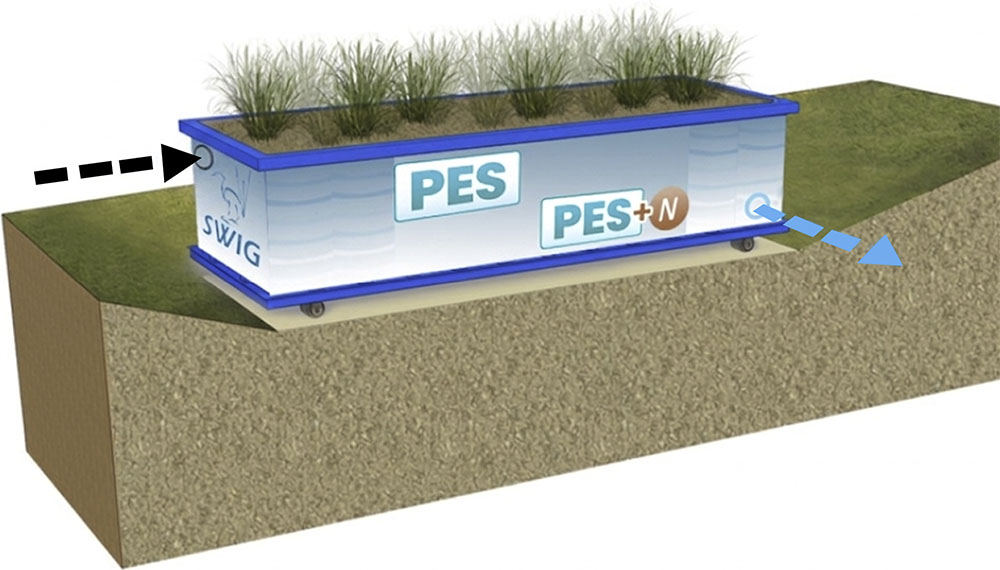
Influent water enters the module and is evenly distributed across the engineered SWIG media layer via an internal water distribution piping system.
Media adsorbs target parameters
As water percolates vertically through the unsaturated media, phosphorus is adsorbed, bioavailable nitrogen is removed through denitirification, and other target parameters are treated based on the selected media blend.
Treated effluent is collected and discharged
Treated water is collected by the underdrain system at the base of the module and conveyed to the discharge point or the next stage of treatment.
SPECIFICATIONS
Module dimensions and performance
| Parameter | Value |
|---|---|
| Capacity | 30 cu. yd (6,048 gal) |
| Length | 22'-8 7/16" |
| Width | 8'-1/2" |
| Height | 76 1/8" |
| Tare weight (empty) | 7,650 lbs |
| Filled weight (media and gravel) | 35,000 lbs |
| Max. daily loading rate | 8,200 gal/day |
| Infiltration rate | 20 - 50 (in/hr) |
| Typical P removal | >80% |
| Typical N removal | 30% – 60% |
Nitrogen removal rate is dependent upon the speciation of nitrogen and whether a denitrification layer is included in the design.
APPLICATIONS
Where is the Module deployed?
- Urban water treatment. Ideal for dense urban settings where land area is limited and in-ground construction is not practical.
- Temporary treatment applications. Can be rapidly deployed and removed for construction site stormwater management, emergency nutrient control, or pilot-scale treatment programs.
- Sites with installation constraints. Suitable for locations where subsurface utilities, shallow bedrock, or right-of-way limitations preclude traditional in-ground systems.
- Scalable configurations. Multiple modules can be deployed in series or parallel to meet higher flow or treatment requirements.
KEY ADVANTAGES
Why choose the Module?
- Configurable media. Compatible with any SWIG media blend, allowing treatment to be tailored to the target parameter and site conditions.
- Rapid deployment. Factory-built and transport-ready, the Module can be delivered and operational in a fraction of the time required for conventional treatment systems.
- Fully automated. Systems operate automatically and are controlled and monitored remotely, minimizing on-site staffing requirements.
- Compact and mobile. Skid-mounted construction allows repositioning or redeployment as project needs change.
- Proven performance. Uses the same SWIG media technology proven in full-scale field systems, with >80 phosphorus removal and 30 to 60% nitrogen removal.
- No excavation required. Above-ground installation eliminates the need for grading, excavation, or utility relocation.
FULL-SERVICE PROJECT SUPPORT
Design and operations services
SWIG provides a complete suite of design and operational support services, ensuring field systems are properly sized, permitted, and performing from day one through the life of the project. Our team works directly with clients from initial feasibility through long-term operations, reducing the burden on project owners and ensuring treatment goals are consistently met.
Services include:
- Feasibility assessment — site evaluation and preliminary sizing based on target parameters, flow volumes, and available land area
- Hydraulic and treatment design — detailed system sizing, media selection, and hydraulic loading calculations tailored to site-specific conditions
- Site layout and engineering drawings — construction-ready design documents for permitting and contractor use
- Permitting support — technical documentation and agency coordination to support regulatory approvals
- Construction oversight — on-site support during installation to ensure design intent is met
- System operations, maintenance, and performance monitoring — remote system control, scheduled maintenance, real-time performance tracking, and regular reporting to verify treatment targets are consistently achieved.
OPERATIONS and MAINTENANCE
Low-maintenance by design
The Module is designed for long-term, low-intervention operation. O&M activities include:

Electrical Costs
Associated with pumping influent water through the module. A remote system can operate with solar panels and pumps.

Water Quality Sampling
Periodic sampling to verify treatment performance and regulatory compliance.

Media Inspection and Replacement
Periodic inspection of media performance with replacement as needed based on adsorptive capacity, typically every 5 to 15 years depending on influent loading.
MORE INFORMATION
MEDIA REPLACEMENT
Long-life media with end-of-life reuse
SWIG Module media is engineered for durability, with design lifetimes ranging from 5 to 15 years depending on influent phosphorus loads. Systems receiving lower concentrations will experience slower media saturation, extending operational life toward the upper end of this range.
When media reaches adsorptive capacity, it is removed and beneficially reused as an agricultural soil amendment, consistent with SWIG’s cradle-to-cradle sustainability approach.
Longevity: Systems treating lower phosphorus concentrations experience slower saturation, maximizing media life and deferring replacement costs.
Design consideration: While SWIG media blends have high infiltration rates, high suspended sediment loads can impact longevity and performance. Pre-treatment should be evaluated where needed.